
smartbuildingmag.com
24
'26
Written on Modified on
Swiss manufacturer powers new production building with vertical solar facade
KELLER Pressure has installed a vertical solar facade with 3,488 modules, SolarEdge inverters and power optimisers at its Winterthur site; together with the rooftop system, it is set to generate around 140 MWh a year and cover 10 percent of its energy demand.
www.solaredge.com
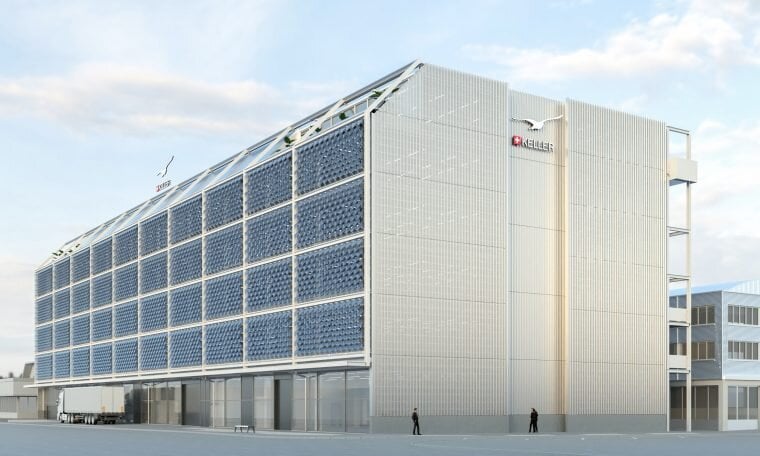
KELLER Pressure, a globally active Swiss manufacturer of high-precision pressure measurement technology, has commissioned an innovative vertical photovoltaic installation on its new Diamant production building in Winterthur, Switzerland. Producing high-precision pressure sensors, pressure transmitters, and measurement systems used across the energy sector, infrastructure projects, and environmental monitoring, the company consumes roughly 3 million kWh of electricity per year—classifying it as a large-scale consumer under the Swiss Energy Act. By investing in on-site photovoltaics, KELLER Pressure reduces its reliance on grid electricity, shields itself against volatile energy prices, and takes a substantial step toward nearly balancing its net energy footprint.
Generating clean energy across facade and roof
Regarded as a milestone in sustainable architecture, the new Diamant building integrates a prominent solar facade directly into its structural envelope. Complementing the rooftop photovoltaic installation, the new vertical system provides 115 kWp across 3,488 modules operated by 4 inverters and power optimisers from SolarEdge. Combined, the solar facade and rooftop installation are projected to generate approximately 140 MWh of clean electricity per year, covering 10 percent of KELLER Pressure's daily energy requirements across offices, production lines, and building services.
Tobias Keller, Managing Director at KELLER Pressure, noted that the Diamant building's solar facade unites high technology, innovation, quality, and precision—the core values the company represents. He emphasised that sustainability is equally vital, demonstrating to customers and stakeholders that the company's commitment extends beyond targets and declarations of intent, while on-site power generation strengthens energy independence and provides greater planning certainty amid volatile global energy markets.
Overcoming shading and architectural constraints
Vertical solar facades on tall buildings face distinct technical challenges compared with conventional rooftop arrays, primarily due to self-shading from the building structure and shadows cast by neighbouring structures. In traditional systems equipped with string inverters, the output of an entire string is dictated by its weakest-performing module, meaning even partial shading on a single panel can noticeably degrade overall system yield.
SolarEdge's DC-optimised technology addresses this limitation by combining inverters with power optimisers, enabling each panel to operate independently so that shading or reduced output on one module does not penalise the rest of the array. Furthermore, whereas conventional string inverters require modules within a string to share similar orientations and operating conditions—forcing architectural compromises—SolarEdge's power optimisers allow panels facing different directions and mounted across multiple planes to be combined within a single system. This flexibility enabled the installer to realise the building's distinctive facade design without sacrificing electrical performance.
Dietmar Staudacher, Country Manager ACH at SolarEdge, added that vertical photovoltaics are gaining importance as companies seek to harvest more renewable energy from their building stock. To unlock this potential, he explained, installations require technology that overcomes the limitations of conventional solar systems, combining advanced power optimisation with architectural freedom so installers can maximise energy yields and deliver the strongest return on investment.
Additional Context:
This section explains general principles of building-integrated photovoltaics (BIPV) and module-level power electronics not included in the original case study.
In conventional series-wired photovoltaic strings, solar modules are connected end-to-end like links in a chain, meaning the electrical current flowing through the entire string is constrained by the module receiving the least solar irradiance. When a vertical building facade experiences dynamic, moving shadows from adjacent structures or angled architectural geometries, unoptimised strings suffer disproportionate power losses and localized hot-spot heating across shaded cells.
DC-optimised inverter architectures resolve this mismatch by placing a dedicated DC-to-DC converter (power optimiser) on each module or pair of modules. Each optimiser continuously tracks the individual Maximum Power Point (MPP) of its connected module and dynamically adjusts output voltage and current to match the fixed-voltage bus required by the central inverter, allowing modules mounted at different azimuths and tilt angles—from vertical walls to flat roofs—to operate at peak efficiency simultaneously.
Edited by an industrial journalist, Lekshman Ramdas, with AI assistance.
www.solaredge.com
