
smartbuildingmag.com
06
'26
Written on Modified on
Commercial Refrigeration Edge Controller Optimization
Danfoss introduced the AK-EC Lite edge controller to simplify monitoring, control, and equipment management across decentralized food service refrigeration and HVAC systems.
www.danfoss.com
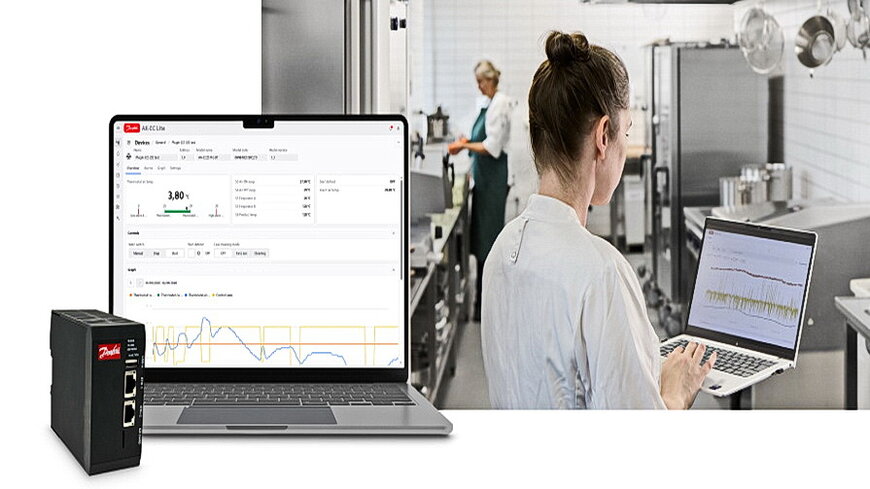
In distributed food service sites such as commercial kitchens, bakeries, and quick-service restaurants, refrigeration and HVAC systems typically rely on independent controls that fragment equipment visibility. This lack of centralized supervision complicates food safety compliance, delays critical temperature alarm response times, and increases the frequency of manual site service visits. To address the engineering challenges of managing disparate equipment without the overhead of heavy enterprise automation systems, decentralized operations increasingly require localized supervisory computing within a connected digital supply chain.
Architecture of the Embedded Edge Platform
The Danfoss Advanced Control Edge (ACE) platform integrates hardware, operational software, and setup tools to supervise decentralized refrigeration and HVAC operations. Operating as a localized supervisory node, the unit functions as an on-site gateway that interfaces directly with underlying refrigeration cases, walk-in coolers, condensing units, and climate systems.
Within this framework, the AK-EC Lite functions as a localized field-level supervisor belonging to the Danfoss ADAP-KOOL series. The hardware architecture merges real-time telemetry processing with a built-in graphical user interface. By consolidating peripheral unit communications into an integrated device layer, technicians can commission nodes, manage dynamic alarms, track temperature excursions, and parameterize field devices from a singular access point.
Communications, Data Logging, and Device Capacity
The edge controller serves as a localized concentration point for small-format refrigeration networks. The system supports up to 15 connected devices across the installation, interfacing with sub-controllers that govern cold rooms, display cases, and preparation counters.
To support regulatory temperature traceability and operational diagnostics, the controller retains up to 150 historical data logs internally. Logging operational parameters directly at the edge provides technicians with continuous records of temperature curves, defrost cycles, and operating states. When setpoint deviations occur, the onboard logic processes alarm thresholds locally, delivering immediate fault annunciation to on-site staff while transmitting diagnostic notifications through secure remote connections.
Operational Workflow and Maintenance Integration
The device framework incorporates preconfigured device models and standardized integration tools to accelerate commissioning schedules. Installers map field devices using predefined profiles, eliminating the need to write custom communication drivers for supported sub-controllers during deployment.
For ongoing lifecycle management, authenticated remote access enables service contractors to conduct initial diagnostics, evaluate alarm histories, and modify operational settings prior to dispatching personnel. This remote interaction framework reduces unnecessary truck rolls for baseline adjustments, shortens troubleshooting intervals during critical cooling failures, and maintains system uptime across commercial food retail operations.
Additional Context
This section details technical specifications and competitive benchmarking not included in the original product announcement.
Small-format commercial food establishments are increasingly transitioning toward decentralized edge computing to meet Hazard Analysis Critical Control Point (HACCP) temperature monitoring mandates without investing in large-scale programmable logic controller (PLC) rack systems. Historically, facilities relied on standalone temperature data loggers or large multi-rack refrigeration managers such as the Danfoss AK-SM 800 series or Emerson Copeland E2/E3 platforms. While multi-rack supervisors typically manage more than 100 device addresses across complex supermarket networks, their cost, physical footprint, and configuration overhead are disproportionately high for small-format kitchens.
Within the distributed food service tier, alternative edge and gateway devices include systems such as the Carel Boss mini and the Dixell X-WEB 300D series. These benchmark supervisory units operate in the range of 6 to 25 connected instruments via standard fieldbus protocols such as Modbus RTU over RS-485. The capacity of the AK-EC Lite to manage up to 15 nodes and 150 logging channels places it directly in this compact footprint class, targeting installations that require localized automated data logging and remote connectivity while maintaining low electrical and physical overhead.
Edited by Evgeny Churilov, Induportals Media - Adapted by AI.
www.danfoss.com
