
smartbuildingmag.com
26
'26
Written on Modified on
Flow-Based HVAC Controllers Optimize Thermal Management in Smart Facilities
Daikin introduces a dedicated plant control platform that integrates with existing building management systems to optimize complex thermal infrastructure across commercial applications.
www.daikin.com
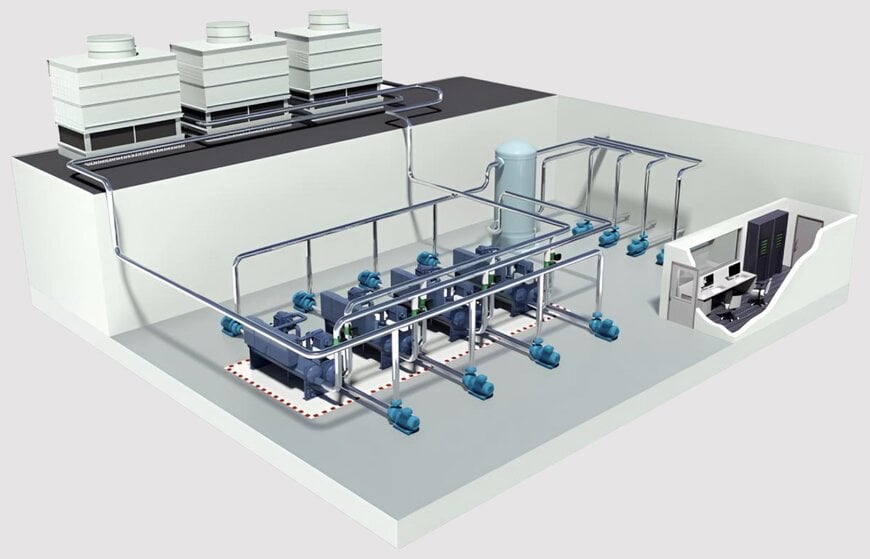
Daikin has released the iCM Pro, a dedicated HVAC plant control platform designed to function in tandem with standard Building Management Systems (BMS). The technology targets engineers and facility managers in hospitals, data centers, and industrial sites requiring optimized thermal load balancing across highly variable operating conditions.
The BMS and Dedicated Plant Control Architecture
While traditional building management systems effectively provide centralized supervision, scheduling, and alarm routing, they often lack the specialized algorithms required to continuously optimize complex heating and cooling equipment. The iCM Pro functions as an intermediate optimization layer within smart building systems. By centralizing the operational logic, the controller coordinates chillers, heat pumps, and heat recovery units without replacing the overarching supervisory functions of the primary BMS. This dual-system approach allows the BMS to maintain plant-wide visibility while the dedicated controller executes targeted performance adjustments to maximize equipment reliability and seasonal efficiency.
Flow-Based Sequencing Mechanisms
Conventional HVAC control systems rely primarily on temperature-based sequencing, which can result in inefficient load sharing and excessive equipment cycling when thermal demands fluctuate. To resolve this, the new platform utilizes flow-based sequencing. By continuously monitoring water flow rates alongside real-time plant demand, the system calculates a highly accurate profile of current operating conditions. This operational logic enables the hardware to adjust capacity dynamically, keeping equipment operating closer to its optimal efficiency range while stabilizing the overall hydraulic network. This accurate response to load changes directly reduces unnecessary cycling and improves runtime balancing across all connected units.
System Scalability and Multi-Vendor Integration
Modern mechanical rooms rarely operate on a single technology, often combining primary-secondary hydraulic layouts, variable-flow systems, and simultaneous heating and cooling setups from various manufacturers. The Daikin architecture is engineered to support this diversity through a vendor-neutral framework, allowing third-party equipment to operate within a single, unified control strategy.
A single iCM Pro control panel can manage up to 16 distinct HVAC units, delivering a combined cooling capacity of up to 144 MW. By supporting both proprietary and vendor-neutral equipment, the system allows industrial facilities to implement phased retrofits and scale their digital infrastructure without being restricted by closed-loop control limitations.
Additional Context
This section details technical specifications and competitive benchmarking not included in the original news release.
The commercial HVAC plant controller market includes established optimization platforms such as the Johnson Controls Central Plant Optimization (CPO) software and the Trane Tracer SC+ system. The Trane Tracer SC+ utilizes predefined chiller plant control applications to sequence up to six chillers in standard configurations. The Johnson Controls CPO application integrates predictive algorithms within the broader Metasys architecture to optimize up to eight chillers and their associated cooling towers. The Daikin iCM Pro differentiates itself in physical scalability and processing volume, offering the capacity to coordinate up to 16 discrete units and manage up to 144 MW of cooling capacity from a single control panel. This expanded hardware limit specifically caters to hyperscale data centers and sprawling industrial complexes that possess cooling load profiles exceeding the parameters of standard commercial optimization applications.
Edited by Aishwarya Mambet, Induportals Editor, with AI assistance.
www.daikinapplied.com
