
smartbuildingmag.com
11
'26
Written on Modified on
Honeywell unveils new portfolio of intelligent fire and life safety innovations
New AI-enabled fire detection, low-level carbon monoxide monitoring and incident command capabilities help reduce nuisance alarms, identify risks earlier and respond with greater confidence.
www.honeywell.com
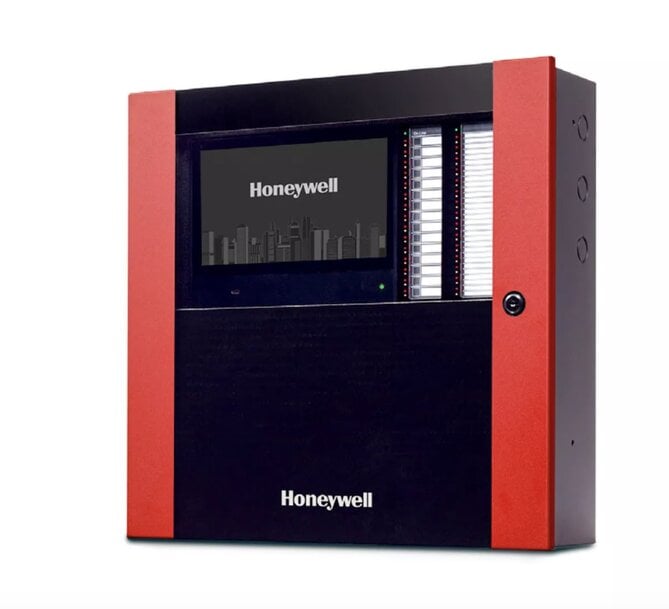
Commercial facilities, healthcare campuses, and industrial plants face persistent challenges balancing early fire detection sensitivity against costly nuisance alarms. Environments containing steam, dust, cooking vapors, or aerosolized mists frequently trigger false alarms in conventional optical smoke detectors, leading to unnecessary building evacuations, dispatch costs, and alarm fatigue. To mitigate false activations, facility operators have historically desensitized detection loops or replaced optical smoke sensors with thermal or flame detectors, introducing dangerous response delays during smoldering, low-energy fire phases. Simultaneously, municipal fire-service crews responding to complex multi-story structures face critical information deficits, arriving on scene with limited visibility into evolving fire spread, occupant density, or real-time atmospheric hazards. Overcoming these life safety limitations requires multi-criteria optical sensors powered by machine-learning classification models, continuous low-level toxic gas trending, and unified telematics portals that stream structural telemetry directly to incident commanders.
AI-Enabled Discrimination and Continuous CO Analytics
To resolve the operational trade-off between sensitivity and false alarm rejection, Honeywell Technologies introduced System Sensor Distinguish detector technology. Unveiled at Accelerate 2026, the company’s flagship Building Automation customer event, the technology applies artificial intelligence classification algorithms directly to multi-criteria optical sensor arrays. System Sensor Distinguish discriminates between genuine combustion aerosols and common ambient nuisance phenomena—such as water steam, airborne dust, cold aerosol mist, and cooking vapors—without requiring operators to switch to delayed thermal spot detection.
Addressing indoor environmental toxicology and life safety, Honeywell expanded its carbon monoxide detection architecture beyond conventional threshold-triggered alarms. Standard life safety codes typically trigger alarms only when carbon monoxide reaches concentration and exposure durations that represent immediate threats to human life. Honeywell’s new sensing layer provides continuous real-time concentration telemetry, historical trend analysis, and cloud-connected telemetry at parts-per-million levels well below statutory emergency thresholds. This granular visibility allows facility engineering teams to detect incomplete HVAC combustion, exhaust leaks, or boiler flue backdrafts before toxic buildup creates long-term health risks or forces emergency building shutdowns.
Incident Command and Situational Awareness for Responders
Complementing its edge-level sensing hardware, Honeywell launched Incident Command, a dedicated software platform engineered to streamline emergency response workflows. Developed through direct collaboration with municipal fire departments, the software consolidates complex building telematics into a single operational interface designed to eliminate cognitive overload for frontline responders.
Incident Command establishes an authenticated, continuous data link between the building’s life safety infrastructure and fire-service command vehicles. The software shares real-time information regarding detector activation sequences, floor-by-floor smoke migration, fire door latch states, and hazardous gas concentrations across every phase of an emergency response—from initial dispatch and en-route tactical planning to active structural containment and post-incident forensic reporting.
Additional Context
This section details technical specifications and competitive benchmarking not included in the original product announcement.
In commercial fire alarm design governed by standards such as NFPA 72 (National Fire Alarm and Signaling Code) and UL 268 (Standard for Smoke Detectors for Fire Alarm Systems, specifically the 7th and 8th Editions), modern optical smoke detection requires strict differentiation between polyurethane foam smoldering fires, flaming paper fires, and nuisance cooking aerosol profiles. Under UL 268 mandates, detectors must resist nuisance trips during standardized frozen hamburger broiling tests while maintaining high sensitivity to fast-flaming polyurethane foam and smoldering wood fires. Achieving this dual-criteria compliance without mechanical filters relies on multi-wavelength optical scattering, combining dual-angle infrared and blue light-emitting diodes (LEDs) with onboard photo-diodes. The ratio of forward-scatter to back-scatter signals, paired with short-wavelength blue scattering, allows internal microprocessors to differentiate small-diameter combustion particulates (typical of active fires) from large-diameter water droplets or mineral dust particles. Concurrently, low-level carbon monoxide monitoring involves calibrated electrochemical cells governed by UL 2075 standards, where micro-ampere current shifts indicate trace toxic gas presence before reaching the time-weighted average exposure boundaries defined by OSHA and NIOSH.
Within the commercial life safety and building automation ecosystem, Honeywell Technologies' System Sensor Distinguish and Incident Command platform benchmark directly against integrated fire portfolios from Johnson Controls (featuring the Simplex TrueAlarm multi-criteria sensors and Connected Fire Services), Siemens Smart Infrastructure (incorporating Cerberus PRO with ASAtechnology and Desigo CC incident management), and Carrier Fire & Security (featuring Kidde Commercial Optica detectors and Edwards Signature Optica series). While competitors like Siemens ASAtechnology utilize parameter-selected algorithmic profiles (such as setting detector modes for telecommunication rooms, kitchens, or cleanrooms) and Carrier’s Optica family focuses on meeting UL 268 7th Edition testing through fixed dual-spectrum optical chambers, Honeywell’s System Sensor Distinguish layers cloud-trained edge machine learning onto its widespread System Sensor field-installed base. Furthermore, while legacy fire alarm systems restrict tactical data access to physical red annunciator panels located inside ground-floor building lobbies, Honeywell’s Incident Command pushes live spatial heat maps and sensor telemetry to cloud-connected tablets, giving dispatch centers and battalion chiefs immediate structural visibility before entry personnel breach a structure.
Edited by Romila DSilva, Induportals Editor, with AI assistance.
www.honeywell.com
