
High-Flow Pressure Independent Control Valves for HVAC
Danfoss redesigns the AB-QM range to optimize district cooling and large HVAC networks with higher nominal flows and reduced differential pressure requirements.
www.danfoss.com
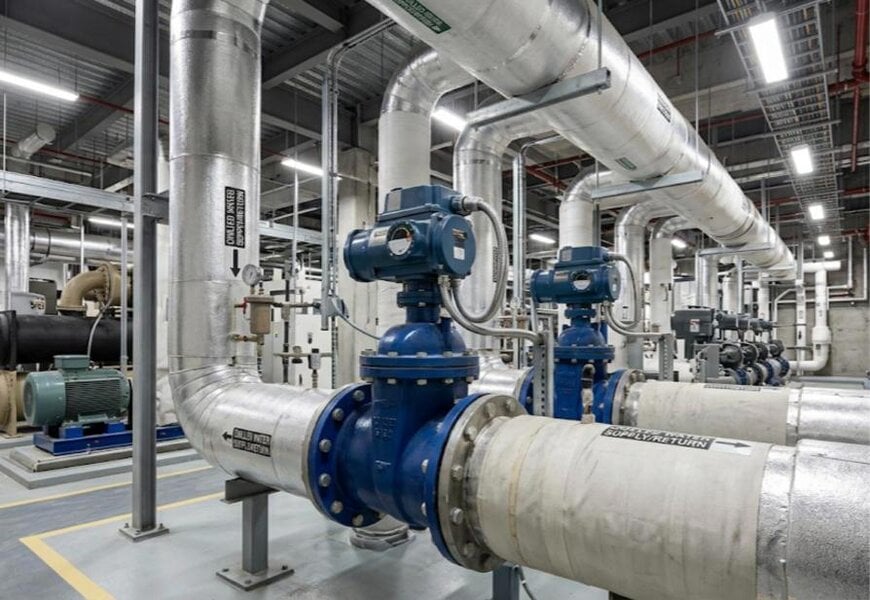
Large-scale climate control environments such as data centers and district cooling networks demand precise hydronic balancing to prevent energy waste and ensure stable system operation. To address these requirements, Danfoss has expanded its pressure independent control valve technology to handle greater capacities while working with smaller actuators.
In expansive hydronic systems, fluctuating pressure conditions often compromise flow accuracy, leading to inefficient chiller operation and unstable temperature control. Traditional balancing valves struggle to maintain valve authority under dynamic load changes, forcing engineers to oversize pumps and actuators to compensate for pressure drops. Optimizing these systems requires control valves that can dynamically adjust to pressure variations while maintaining high flow at lower starting pressures.
Redesigned Architecture for the AB-QM Range
Danfoss has redesigned and expanded its AB-QM range of Pressure Independent Control Valves (PICVs) for sizes DN 125 to DN 250. The update increases nominal flows by 5 to 60 percent across the size L range, with an average increase of 30 percent. The core functionality remains unchanged: thanks to pressure-independent operation, the valves maintain a valve authority close to 100 percent, alongside a control range of 1:1000.
Smaller Actuators and Reduced Starting Pressures
Lowering the energy required to drive hydronic systems is a primary objective in modern HVAC design. The redesigned standard AB-QM models in DN 125-250 now feature a lower differential pressure requirement, operating with a starting pressure of 40 kPa, while the High Flow variants require 60 kPa. The DN 200 and DN 250 valves no longer require the digital NovoCon XL actuator; the smaller NovoCon L actuator is now sufficient. Furthermore, the robustness of the entire range has been upgraded, raising the maximum allowed differential pressure from 600 kPa to 800 kPa for all valves.
Super High Flow Models for Data Center Applications
To support large HVAC, data center and district cooling applications, two new Super High Flow models have been introduced. The DN 250 SHF model provides a nominal flow of 600 m³/h with a starting pressure of 80 kPa. For even larger loads, the DN 250 SHF+ model handles a nominal flow of 670 m³/h at a 100 kPa starting pressure. Detailed datasheets and specifications are available in the Danfoss AB-QM eBrochure.
Additional Context
This section details technical specifications and competitive benchmarking not included in the original product announcement.
In the commercial HVAC and district cooling sectors, the adoption of Pressure Independent Control Valves has become a fundamental engineering standard to achieve variable primary flow efficiency. Traditional hydronic networks relied on complex combinations of manual balancing valves and two-way control valves, which required constant re-commissioning as system demands changed. By consolidating balancing and control into a single unit, these components eliminate hydraulic cross-talk between terminal units. Maintaining a valve authority near 100 percent is critical; it ensures that the control signal strictly dictates the flow rate, unaffected by pressure fluctuations elsewhere in the network. The shift towards lower starting pressures directly translates to reduced pump head requirements, enabling significant electrical savings on variable speed drive circulation pumps over the lifespan of a data center or commercial facility.
Edited by Maria Brueva, Induportals editor – adapted by AI.
