
smartbuildingmag.com
19
'26
Written on Modified on
Vertiv introduces the PowerNexus MV UPS system for AI data centres
The outdoor medium-voltage platform accelerates grid connection, frees up indoor space for compute and achieves peak efficiency of up to 98.5%.
www.vertiv.com
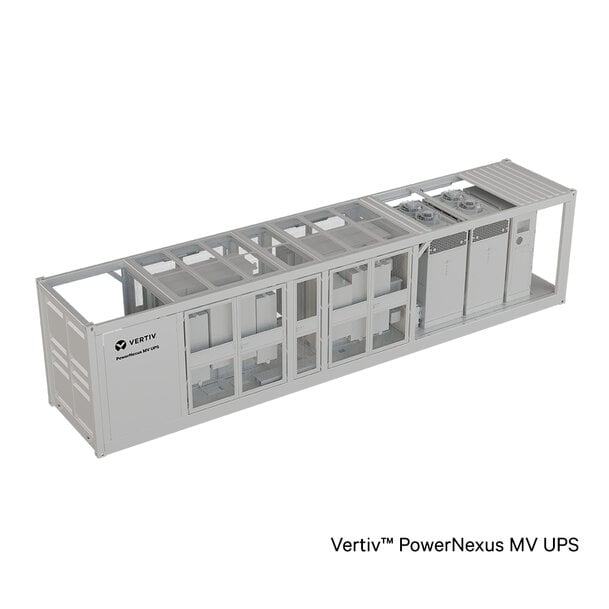
Vertiv has introduced Vertiv PowerNexus MV UPS, a medium-voltage power solution designed to help colocation, neocloud and hyperscale data centre operators accelerate grid connections, optimise site utilisation and support evolving grid requirements. Designed for outdoor installation at the point of grid connection, the system combines medium-voltage UPS, fault ride-through capabilities and AI power stabilisation in a single platform, delivering continuous power protection while preserving valuable indoor space for revenue-generating compute resources. Vertiv is collaborating with customers globally and expects to begin deliveries from mid-2027.
A response to emerging infrastructure challenges
According to Kyle Keeper, senior vice president of Vertiv's Power Management business unit, new infrastructure challenges are emerging in data centres, including grid connection queues, which can delay site activation and revenue generation, indoor space constraints, which limit compute density, and evolving power grid requirements. Vertiv PowerNexus MV UPS was conceived as a systemic response to these challenges: an outdoor platform engineered to operate with long-duration energy storage systems, enabling operators to focus on deploying compute capacity rather than coordinating infrastructure.
Class 1 protection, efficiency and reduced reliance on diesel
Designed to integrate with long-duration battery systems, the system provides Class 1 output voltage quality in compliance with IEC 62040-3, helping to protect critical loads during power grid disturbances and upstream faults. An outdoor-rated skid moves critical power infrastructure outside the data hall, while fault ride-through and AI power stabilisation functions support grid stability under fault conditions and absorb rapid load fluctuations typical of AI before they reach the grid. The line-interactive topology delivers efficiency of up to 98.5% under peak conditions and, when integrated with long-duration storage systems, the system can provide up to four hours of battery runtime, reducing the use of diesel generators for long-duration backup. The single-vendor skid architecture reduces coordination complexity across the UPS, batteries and other components in the power chain, and a PSCAD (Power Systems Computer Aided Design) model allows customers to simulate system behaviour and grid interactions prior to deployment.
Performance confirmed by customer demonstrations
Vertiv recently hosted proof-of-concept demonstrations with QTS, SoftBank and Rosendin at its Global Power R&D and Customer Experience Center in Bologna. The tests, conducted under various static and dynamic conditions, demonstrated stable performance across loads ranging from 0% to 100%, Class 1 voltage accuracy during rapid load changes and the ability to ride through significant voltage disturbances, including a 100% voltage sag for 150 milliseconds and a 25% overvoltage for five seconds. According to Ryan Kuithe, senior vice president, facilities operations at QTS, the tests validated the system's ability to maintain stable power in the presence of dynamic load changes and voltage disturbances.
A dedicated medium-voltage laboratory in Bologna
Vertiv is also planning a dedicated medium-voltage laboratory at its Global Large Power R&D and Customer Experience Center in Bologna, scheduled to become operational in 2027. The centre will support R&D activities, full-voltage validation, customer demos, technical training and system-level testing for medium-voltage power architectures, including MV UPS solutions, medium-voltage to 800 VDC conversion and battery energy storage technologies, and will be available to customers worldwide for demos and system validation. According to Giovanni Zanei, vice president, large power conversion at Vertiv, the facility will help customers evaluate new architectures with greater confidence when planning power systems for large-scale AI data centres, including those based on 800 VDC.
Additional Context:
This section illustrates general principles of medium-voltage power and AI loads that are not included in the original press release.
In data centres, power is generally drawn from the grid at medium voltage and stepped down to low voltage before being distributed to IT equipment, often via UPS units installed inside the building. For a given amount of power, medium voltage requires lower currents than low voltage, and placing power protection closer to the grid connection point can help free up space inside the building.
AI compute workloads can fluctuate very rapidly as large clusters of processors switch from idle to full load. These fluctuations can affect voltage quality and grid stability. Fault ride-through functions allow a facility to remain connected during brief grid disturbances, while storage and stabilisation systems can absorb or supply energy to smooth out rapid load variations.
Edited by an industrial journalist, Lekshman Ramdas, with AI assistance.
www.vertiv.com
