
smartbuildingmag.com
26
'26
Written on Modified on
LONGi launches Hi-MO X12 in Europe
New module architecture delivers up to 20 W additional power, eliminates more than 15,000 potential solder-joint failure points and reduces internal mechanical stress by 60%.
www.longi.com
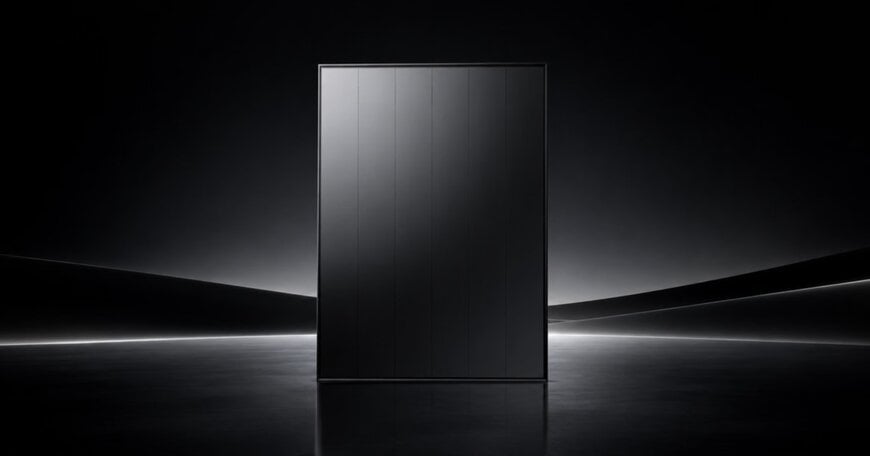
Commercial, industrial, and residential solar developers across Europe face growing pressure to maximize power density per square meter of constrained rooftop space while safeguarding long-term module reliability against thermal cycling, microcracking, and moisture ingress. Conventional photovoltaic modules rely on soldered copper-tin-lead ribbons to interconnect adjacent solar cells, introducing series electrical resistance and creating localized thermomechanical stress due to coefficient-of-thermal-expansion mismatches between silicon wafers and metallic ribbons. Furthermore, visible inter-cell spacing reduces active light-capturing area and detracts from architectural aesthetics on residential roofs, while standard polymeric backsheets remain vulnerable to moisture permeation in humid environments. Overcoming these electrical, mechanical, and optical losses requires ribbon-free conductive foil backplane interconnections paired with gapless back-contact cell layouts and moisture-impermeable barriers.
Integrated Conductive Interconnection and Moisture Barrier Engineering
To boost power output and long-term structural durability, LONGi equipped the Hi-MO X12 series with its Integrated Conductive Interconnection (ICI) architecture, replacing traditional soldered metal ribbons with a continuous sheet of conductive metal foil extending over 400 meters per module. By bonding directly to the back-contact cells, the foil eliminates more than 15,000 potential solder-joint failure points while expanding the conductive cross-sectional area by 85 percent—lowering resistive losses to gain 6 to 8 W of additional module power. Eliminating rigid solder joints reduces internal mechanical stress by 60 percent, dropping from 50 MPa to 20 MPa to mitigate microcracking during transport and installation. Concurrently, a gapless cell layout combining overlapping cells with hidden busbars maximizes active module area for up to 12 W of extra output, bringing total ICI-driven power gains to 20 W.
To protect against environmental degradation in humid climates, ICI also integrates a continuous metal foil barrier that lowers the water vapor transmission rate (WVTR) by 90 percent. Supported by this moisture-blocking and stress-relieved design, the Hi-MO X12 carries a 30-year linear power warranty guaranteeing at least 88.85 percent of rated output after three decades, with maximum degradation capped at 1 percent in year one and 0.35 percent annually thereafter.
Commercial, Industrial, and Residential Portfolio Rollout
Built upon LONGi’s established HPBC 2.0 back-contact cell platform—which combines shading optimization with proprietary TaiRay silicon wafers—the European Hi-MO X12 portfolio spans six commercial and industrial (C&I) variants alongside two residential EcoLife models, with European deliveries scheduled to begin in January 2027:
- C&I Configurations: Offered in 54-cell, 60-cell, and 72-cell formats delivering up to 690 W and a maximum module efficiency of 25.72 percent, giving installers sizing flexibility across diverse commercial rooftops.
- EcoLife Residential Variants: Available in single-glass and dual-glass constructions rated up to 500 W, leveraging the gapless cell design to achieve a uniform, mirror-like all-black surface free of visible inter-cell grids.
Additional Context
This section details technical specifications and competitive benchmarking not included in the original product announcement.
In high-efficiency photovoltaic module engineering governed by IEC 61215 (design qualification and type approval) and IEC 61730 (photovoltaic module safety), back-contact architectures relocate all positive and negative electrical contacts to the rear surface of the n-type wafer, eliminating front-grid optical shading. Integrating a continuous conductive foil backplane (conceptually related to conductive backsheet and foil-interconnection architectures) replaces narrow cylindrical or flat ribbons with planar current collection, lowering series resistance while isolating moisture ingress pathways that otherwise trigger ethylene-vinyl acetate (EVA) encapsulant hydrolysis and acetic acid corrosion.
Within the European high-efficiency back-contact and C&I rooftop solar module market, LONGi’s Hi-MO X12 benchmarks directly against Maxeon Solar Technologies (Maxeon 6 and Maxeon 7 IBC modules), Aiko Solar (ABC Neostar and Comet series), SunPower, and high-power TOPCon offerings from JinkoSolar (Tiger Neo), Trina Solar (Vertex S+ and Vertex N), and JA Solar (DeepBlue 4.0 Pro). While Aiko Solar has aggressively marketed All-Back-Contact (ABC) modules in Europe around 24–25 percent efficiency and Maxeon leads legacy interdigitated back-contact reliability, LONGi’s combination of HPBC 2.0 cells, ribbon-free conductive foil interconnection, and 25.72 percent C&I efficiency raises the power-density benchmark for space-constrained European commercial rooftops.
Edited by Romila DSilva, Induportals Editor, with AI assistance.
