
smartbuildingmag.com
13
'26
Written on Modified on
Huawei launches LUTERRA S2 SiC residential energy system
The all-in-one platform integrates a hybrid inverter, battery storage and AI energy management on a fanless, full-SiC architecture.
www.huawei.com
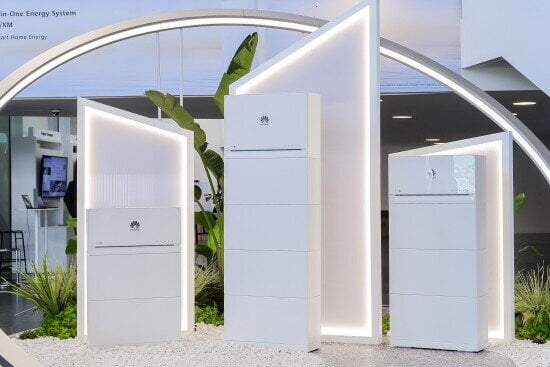
Huawei has launched HUAWEI LUTERRA S2, an all-in-one residential energy system that integrates a hybrid inverter, battery storage and AI-powered energy management in a single stackable unit. Announced in Palma, Spain, the system is designed for straightforward deployment and can be installed and commissioned in minutes. It is available in single-phase (3 to 10 kW) and three-phase (5 to 20 kW) configurations and responds to the growing convergence of solar generation, storage, EV charging and home energy management. According to Steve Zhang, President of Huawei Distributed PV & BESS Business, the combination of full-SiC architecture, AI-driven energy management and safety features makes the system smaller, lighter, quieter, safer and more powerful than before.
Full-SiC architecture and silent operation
According to Huawei, LUTERRA S2 is the industry's first all-in-one residential energy system built on its proprietary full-SiC (silicon carbide) architecture. Combined with an ANPC (Active Neutral Point Clamped) topology, it achieves up to 99% efficiency and delivers 20 kW-class power in a compact form factor. The company describes its all-natural cooling design as the first in the 20 kW class: it eliminates external fans and keeps operating noise below 29 dB. Built-in energy optimizers enable up to 5.0 MWh/kWh of lifetime usable energy, and the design lifespan exceeds 15 years. The Red Dot Award-winning hardware is complemented by App 3.0 and an intelligent breathing light.
AI-driven energy management
The AI Energy Management 2.0 platform integrates weather forecasts, electricity prices, household loads and energy status to coordinate photovoltaic generation, energy storage, EV charging, heat pumps and virtual power plants (VPPs), with the aim of maximising the value of every kilowatt-hour generated, stored and consumed. For homeowners, an AI Assistant enables energy management through conversational interaction. For installers, AI 3D modelling identifies roof structures and installation environments to simplify planning and design, while AI-powered diagnostics and remote support improve operation and maintenance efficiency.
Cell-level and system-level safety
Each battery cell incorporates an independent protective isolation structure, supported by Huawei-developed safety components and a localised non-propagation design to help contain thermal risks. An intelligent smoke-duct design provides directional pressure relief, smoke evacuation and cooling, while continuous AC and DC terminal temperature detection protects critical connections. The system has been validated against relevant EU Battery Regulation requirements, complies with IEC 63027 AFCI and has undergone UL 9540A validation. TÜV Rheinland testing included a cell thermal runaway test, a 20-minute fire test at 1,000°C and a 20% hydrogen explosion test, and LUTERRA S2 has received the highest-level Safety Mark certification from TÜV Rheinland.
Additional Context:
This section explains general principles of silicon carbide power electronics and multilevel inverter topologies not included in the original press release.
Residential hybrid inverters convert direct current (DC) from solar panels and batteries into alternating current (AC) for household use. Conventional designs often rely on silicon switching devices, whose switching and conduction losses are dissipated as heat that must be removed, frequently with fans at higher power ratings.
Silicon carbide is a wide-bandgap semiconductor. SiC transistors can switch faster and with lower losses than comparable silicon devices, and they tolerate higher temperatures and voltages. In a multilevel topology such as ANPC, the DC-link voltage is shared across several switching devices, reducing the voltage stress on each one and producing an output waveform closer to a sine wave with lower harmonic distortion. Lower losses mean less heat to dissipate, which is what makes passive cooling feasible at higher power levels in compact enclosures.
Edited by an industrial journalist, Lekshman Ramdas, with AI assistance.
www.huawei.com
