
Electronic Step Relays for Flush-Mounted Lighting Control
Finder expands its Series 13 electronic step relays with three flush-mounted models to simplify wiring and manage LED lighting loads.
www.findernet.com
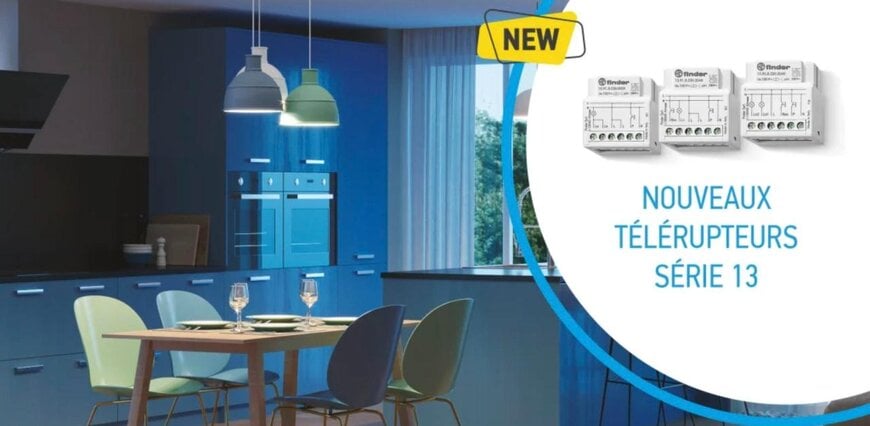
Modern residential and commercial electrical installations require compact switching devices capable of fitting inside tight flush-mounted wall boxes while safely handling the electrical characteristics of LED lighting. To address these installation and load-management constraints, Finder has expanded its Series 13 lineup with three new electronic step relays: models 13.9C.8.230.0000, 13.91.8.230.0040 and 13.95.8.230.0040.
Installers working in residential and tertiary buildings frequently face limited space inside standard flush-mounted electrical boxes, where managing multiple control wires and daisy-chained connections increases assembly time and wiring complexity. At the same time, the widespread adoption of LED lighting introduces high capacitive inrush currents that can prematurely degrade standard switching contacts. Electrical switching components must therefore combine compact dimensions with reliable load handling and strict compliance with fixed-installation safety regulations.
Series 13 Architecture and Regulatory Compliance
The three new Series 13 electronic step relays are designed for installation inside flush-mounted boxes, enabling multi-point lighting control directly where it is needed. All three models support switching loads up to 10 A and are designed for easier and faster wiring during installation. The devices comply with the EN 60669-1 and EN 60669-2-1 standards, ensuring electrical safety in fixed domestic and commercial installations.
Functional Configurations of the New Relay Models
The Type 13.9C (model 13.9C.8.230.0000) is an electronic step relay equipped with doubled terminals. This terminal design simplifies loop-in and loop-out wiring directly at the device, reducing the need for separate terminal blocks inside crowded wall boxes. It is rated for LED lamp loads up to 300 W.
The Type 13.91 (model 13.91.8.230.0040) operates as a bifunction relay, combining standard step relay switching with a timed step relay mode. The timing function can be set to 2 seconds, 6 minutes or 10 minutes, making it suitable for corridors, stairwells or utility areas where automatic switch-off prevents unnecessary energy consumption. The device also incorporates a RESET function for centralised switch-off and supports LED lamp loads up to 300 W.
The Type 13.95 (model 13.95.8.230.0040) is a 4-sequence step relay with 2 contacts, enabling sequential control of two lighting circuits from a single pushbutton network. Like the 13.91 model, it integrates a RESET function for centralised switch-off and is rated for LED lamp loads up to 250 W.
Additional Context
This section details technical specifications and competitive benchmarking not included in the original product announcement.
In building electrical engineering, the distinction between a relay’s nominal resistive current rating (such as 10 A) and its rated LED lamp load (250 W to 300 W) is a critical specification parameter. Unlike traditional incandescent bulbs, LED drivers contain capacitive power supplies that draw brief, high-amplitude inrush currents at the moment of switching. Without suitable contact materials or electronic switching control, these current peaks can cause contact welding and premature device failure.
Compliance with EN 60669-1 defines the general mechanical and electrical safety requirements for fixed household and similar electrical switches, while EN 60669-2-1 establishes particular requirements for electronic switches. Compared to legacy electromechanical impulse relays, flush-mounted electronic step relays offer silent operation and integrate logic functions such as timed switch-off and centralised reset commands within a compact form factor.
Edited by Maria Brueva, Induportals editor – adapted by AI.
