
Dual-Lens TandemVu Camera with 4G Connectivity
HiWatch expands its TandemVu range with a 4G dual-lens camera that combines a fixed overview and a PTZ with optical zoom in a single device.
www.hikvision.com
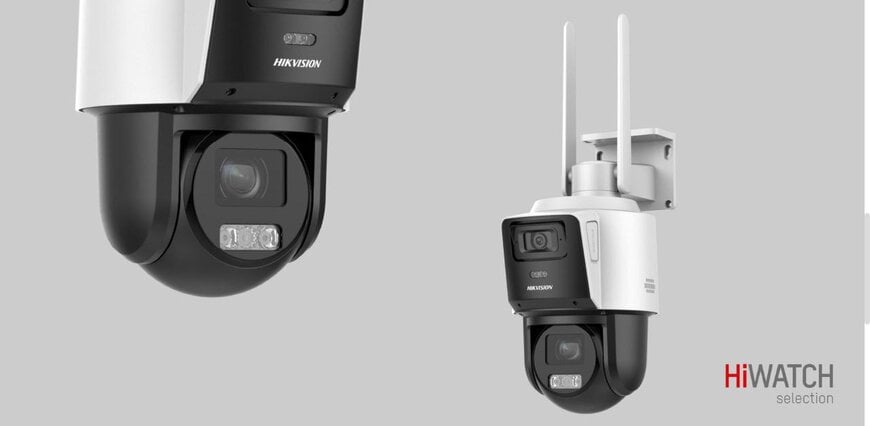
Securing outdoor areas such as courtyards, parking lots, construction sites and detached properties requires continuous wide-angle awareness while still capturing close-up details, ideally without multiple cameras or long cable runs. To address these needs, the HiWatch selection has expanded its TandemVu camera range with a 4G mobile network model alongside the existing wired versions.
In conventional outdoor video surveillance, electrical installers often face a trade-off between fixed cameras and pan-tilt-zoom (PTZ) units. A PTZ camera can zoom in on activity near a gate, but while it follows a target, the overview of the wider area is lost. Installing separate fixed and PTZ cameras increases hardware, mounting work and cabling, and remote sites often have no Ethernet infrastructure at all.
Dual-Channel Optical Architecture
TandemVu cameras integrate a fixed camera and an adjustable PTZ in a single device, offering both overall control and detailed observation from one installation point. The 4G model features two 2 MP channels: the fixed channel, with a 2.8 mm lens, maintains the general view, while the PTZ channel, with a 2.8–12 mm lens and 4x optical zoom, brings the point of interest closer. Even during PTZ movement and zooming, the fixed view remains available, helping to reconstruct the context of what is happening.
4G Connectivity and Wired PoE+ Option
The 4G model is suited to parking lots, outdoor depots, construction sites and detached properties where running an Ethernet cable would require complex work, provided mobile coverage has been checked and a data SIM is available. The camera requires a 12 V DC power supply, allowing installers to plan the necessary provisions clearly.
The same dual-view concept is offered by the wired DS-2SE3C204MWG-E/12, which can also be powered via PoE+, simplifying connection by using the network cable for both data and power. Integrating both views reduces the number of devices to be mounted compared with a solution using separate fixed and PTZ cameras.
Detection, Night Vision and Outdoor Protection
On both models, person and vehicle detection helps focus attention on relevant events. 120 dB WDR handles scenes with strong light contrast, while the fixed channel offers IR and white-light illumination up to 30 metres and the PTZ reaches 40 metres with infrared. IP66 protection allows outdoor use, and Hik-Connect enables remote viewing of images. For installers, choosing between wired and 4G means adapting the offer to real site conditions while keeping the advantage of dual vision.
Additional Context
This section details technical specifications and competitive benchmarking not included in the original product announcement.
In commercial security engineering, dual-sensor cameras combining a fixed overview with a PTZ module are becoming a common approach for perimeter protection. Traditionally, simultaneous wide-angle coverage and optical zoom required pairing a fixed bullet or dome camera with a separate PTZ dome, doubling switch ports, video management licences and mounting brackets. Consolidating both optical paths in one housing reduces installation labour and hardware footprint.
From an imaging perspective, 120 dB WDR is an important benchmark for entrances and vehicle gates, where bright sunlight or headlights against shaded areas would otherwise saturate standard image sensors. For off-grid 4G deployments, on-camera human and vehicle classification is particularly valuable, as filtering irrelevant motion such as foliage or animals reduces false alarms and conserves mobile data.
Edited by Maria Brueva, Induportals editor – adapted by AI.
