
smartbuildingmag.com
26
'26
Written on Modified on
How Sensor Fusion Cuts Empty-Room HVAC Waste
VergeSense, Density and Siemens' Enlighted turn AI occupancy sensing into live headcounts, letting building systems throttle airflow wherever hybrid offices sit empty.
induportals-media-publishing.com
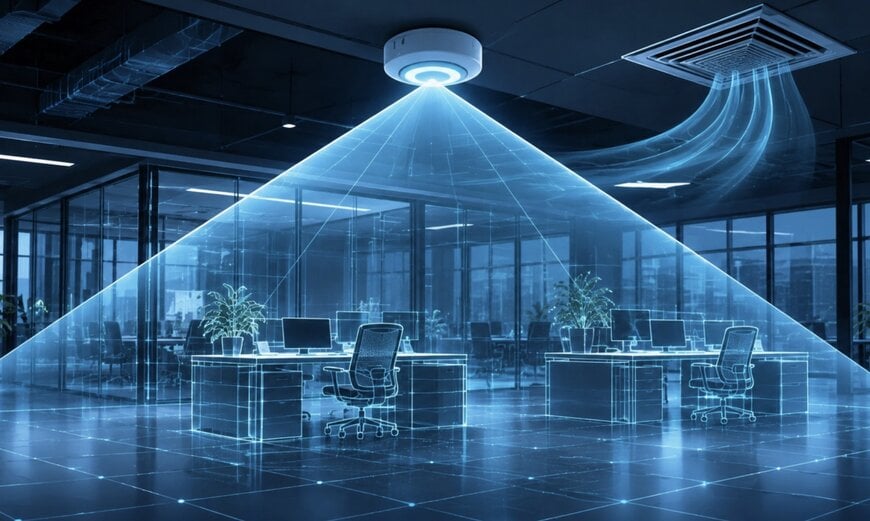
AI-generated image.
Schedule-based HVAC sequences condition every zone during fixed hours, regardless of how many people are present. In hybrid offices, that means heating, cooling and ventilating rooms and floors that often sit empty. Occupancy-based HVAC control feeds live presence and headcount data to the building management system (BMS), enabling setpoint setbacks, lower outdoor-air volumes and shorter runtimes in unused zones while occupied areas stay within comfort limits.
Current Technology Market Landscape
According to the U.S. Energy Information Administration, space heating (30 percent) and ventilation (20 percent) together account for half of end-use energy in U.S. office buildings. Sensing methods range from passive infrared (PIR) motion detection to millimetre-wave radar and on-device computer vision. The difference matters: Conventional PIR motion sensors register movement and can read a seated occupant as absent, while counting sensors report the headcounts that demand-controlled ventilation needs to size outdoor-air rates.
Core Market Challenge
HVAC zones rarely match room boundaries, so one air handler may serve spaces with different occupancy. Wired sensors need Power over Ethernet (PoE) cabling, while battery units add maintenance planning. Optical hardware can trigger privacy reviews and works council consultation. Savings appear only once BMS sequences are reprogrammed to act on occupancy data.
Existing Technology Solutions
VergeSense's Infinity area sensor runs its AI models on the device, so images are never transmitted or stored. Only anonymous counts leave the unit, encrypted with TLS 1.3. VergeSense rates it at 95 percent accuracy, versus the 60 to 70 percent it attributes to PIR sensors. A 160-degree field of view lets one sensor cover a full room. The sensor also detects passive occupancy, such as laptops or bags left on desks. This matters for HVAC because a briefly vacated room should not trigger a setback. The battery-powered unit mounts magnetically, connects over a wireless mesh, carries a ten-year battery and receives model updates over the air.
Density's Open Area sensors use a single-chip 60 to 64 GHz millimetre-wave radar of Density's own design. The radar generates depth points from small movements in three-dimensional space and clusters them to count people. Density states this method is unaffected by sunlight or reflectivity and is anonymous at source. The Long Range model covers 1,000 square feet from ceilings up to 20 feet. The Short Range model targets phone booths and low-ceiling rooms and can be mounted as low as 6.5 feet. Both are powered via 802.3af PoE at 15.4 W per port. This delivers continuous data without batteries but requires a network cable to every sensor location.
Sensors from Enlighted, a Siemens company, are installed in light fixtures and draw power from them, so no batteries are needed. Each sensor combines a digital PIR motion sensor, ambient light and temperature sensing, energy metering through the fixture's control unit, and a Bluetooth Low Energy radio, sampling 65 times per second. Each sensor covers roughly 100 square feet, creating a dense sensing grid wherever luminaires are installed. USB-powered Surface Sensors cover desks and conference rooms independently of the lighting. The wireless mesh scales to more than 18,000 sensors per building and uses AES 128-bit encryption for wireless transmission. Data reaches building management systems and third-party platforms through standard integrations and REST APIs. Enlighted cites up to 35 percent HVAC energy savings.
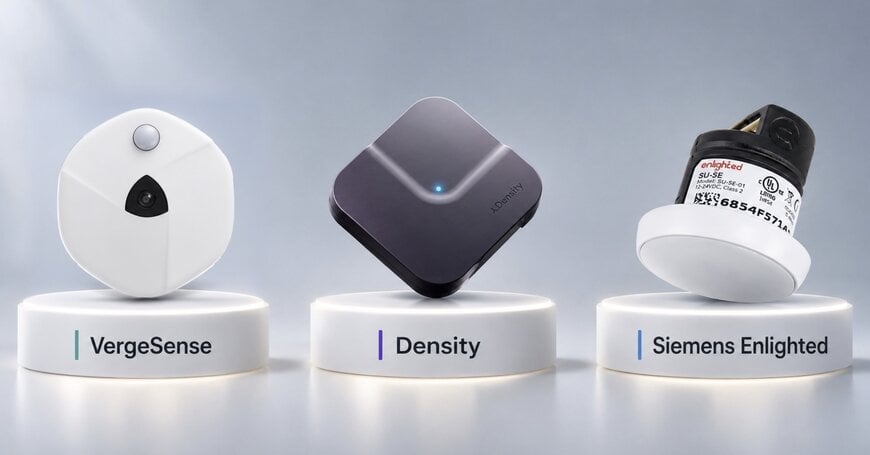
Occupancy sensors compared (left to right): VergeSense Infinity area sensor, Density Open Area radar sensor and Enlighted Micro Sensor (Siemens). Images: VergeSense, Density, Enlighted.
Actual implementation on the ground
According to VergeSense, a global investment bank linked occupancy data to the Switch Automation platform at its New York office and achieved up to 30 percent daily energy savings by aligning HVAC schedules with actual use. In a case study published by Density, a global e-commerce company deployed its sensors across 700,000 square feet, found 26 to 45 percent of desks unused daily and saved 1.02 million U.S. dollars a year at one building by consolidating space. Enlighted states that a lighting retrofit at Siemens Energy's Parsons Works manufacturing site in Newcastle, UK, is on track to save over 5.6 million kWh annually, with the site planning to use the same occupancy data for heating and cooling.
Summary and Strategic Future Outlook
Vision, radar and fixture-based sensing differ in installation effort and data detail, but they serve one function: supplying reliable occupancy inputs to smart building systems. Control is moving toward prediction. In June 2026, Siemens' Building X added a beta AI-based schedule recommendation that forecasts occupancy two weeks ahead to set eco or comfort modes, and VergeSense reports that its investment bank customer is exploring similar next-week occupancy forecasting. If such forecasts prove reliable, HVAC plants could pre-condition spaces for expected attendance instead of fixed timetables, turning occupancy data from a reactive control signal into a planning input for energy management.
Edited by Aishwarya Mambet, Induportals Editor, with AI assistance.
www.smartbuildingmag.com
Schedule-based HVAC sequences condition every zone during fixed hours, regardless of how many people are present. In hybrid offices, that means heating, cooling and ventilating rooms and floors that often sit empty. Occupancy-based HVAC control feeds live presence and headcount data to the building management system (BMS), enabling setpoint setbacks, lower outdoor-air volumes and shorter runtimes in unused zones while occupied areas stay within comfort limits.
Current Technology Market Landscape
According to the U.S. Energy Information Administration, space heating (30 percent) and ventilation (20 percent) together account for half of end-use energy in U.S. office buildings. Sensing methods range from passive infrared (PIR) motion detection to millimetre-wave radar and on-device computer vision. The difference matters: Conventional PIR motion sensors register movement and can read a seated occupant as absent, while counting sensors report the headcounts that demand-controlled ventilation needs to size outdoor-air rates.
Core Market Challenge
HVAC zones rarely match room boundaries, so one air handler may serve spaces with different occupancy. Wired sensors need Power over Ethernet (PoE) cabling, while battery units add maintenance planning. Optical hardware can trigger privacy reviews and works council consultation. Savings appear only once BMS sequences are reprogrammed to act on occupancy data.
Existing Technology Solutions
VergeSense's Infinity area sensor runs its AI models on the device, so images are never transmitted or stored. Only anonymous counts leave the unit, encrypted with TLS 1.3. VergeSense rates it at 95 percent accuracy, versus the 60 to 70 percent it attributes to PIR sensors. A 160-degree field of view lets one sensor cover a full room. The sensor also detects passive occupancy, such as laptops or bags left on desks. This matters for HVAC because a briefly vacated room should not trigger a setback. The battery-powered unit mounts magnetically, connects over a wireless mesh, carries a ten-year battery and receives model updates over the air.
Density's Open Area sensors use a single-chip 60 to 64 GHz millimetre-wave radar of Density's own design. The radar generates depth points from small movements in three-dimensional space and clusters them to count people. Density states this method is unaffected by sunlight or reflectivity and is anonymous at source. The Long Range model covers 1,000 square feet from ceilings up to 20 feet. The Short Range model targets phone booths and low-ceiling rooms and can be mounted as low as 6.5 feet. Both are powered via 802.3af PoE at 15.4 W per port. This delivers continuous data without batteries but requires a network cable to every sensor location.
Sensors from Enlighted, a Siemens company, are installed in light fixtures and draw power from them, so no batteries are needed. Each sensor combines a digital PIR motion sensor, ambient light and temperature sensing, energy metering through the fixture's control unit, and a Bluetooth Low Energy radio, sampling 65 times per second. Each sensor covers roughly 100 square feet, creating a dense sensing grid wherever luminaires are installed. USB-powered Surface Sensors cover desks and conference rooms independently of the lighting. The wireless mesh scales to more than 18,000 sensors per building and uses AES 128-bit encryption for wireless transmission. Data reaches building management systems and third-party platforms through standard integrations and REST APIs. Enlighted cites up to 35 percent HVAC energy savings.
Occupancy sensors compared (left to right): VergeSense Infinity area sensor, Density Open Area radar sensor and Enlighted Micro Sensor (Siemens). Images: VergeSense, Density, Enlighted.
Actual implementation on the ground
According to VergeSense, a global investment bank linked occupancy data to the Switch Automation platform at its New York office and achieved up to 30 percent daily energy savings by aligning HVAC schedules with actual use. In a case study published by Density, a global e-commerce company deployed its sensors across 700,000 square feet, found 26 to 45 percent of desks unused daily and saved 1.02 million U.S. dollars a year at one building by consolidating space. Enlighted states that a lighting retrofit at Siemens Energy's Parsons Works manufacturing site in Newcastle, UK, is on track to save over 5.6 million kWh annually, with the site planning to use the same occupancy data for heating and cooling.
Summary and Strategic Future Outlook
Vision, radar and fixture-based sensing differ in installation effort and data detail, but they serve one function: supplying reliable occupancy inputs to smart building systems. Control is moving toward prediction. In June 2026, Siemens' Building X added a beta AI-based schedule recommendation that forecasts occupancy two weeks ahead to set eco or comfort modes, and VergeSense reports that its investment bank customer is exploring similar next-week occupancy forecasting. If such forecasts prove reliable, HVAC plants could pre-condition spaces for expected attendance instead of fixed timetables, turning occupancy data from a reactive control signal into a planning input for energy management.
Edited by Aishwarya Mambet, Induportals Editor, with AI assistance.
www.smartbuildingmag.com
