
smartbuildingmag.com
25
'26
Written on Modified on
Power Electronics for Hybrid AC/DC Electrical Distribution
Schneider Electric introduces InterLink Converter, solid-state circuit breakers and TeSys iMCC for microsecond protection and control in hybrid AC/DC distribution.
www.se.com
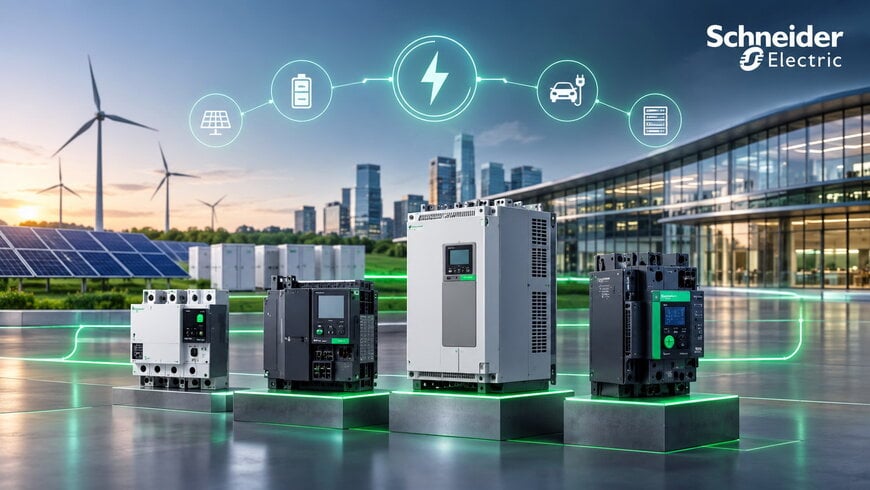
Renewable generation, battery storage, electric vehicle charging and high-density loads are turning electrical distribution into a network of bidirectional, increasingly direct current (DC) power flows that conventional mechanical switchgear was not designed for. Schneider Electric has presented a portfolio of power electronics-based devices for protection, conversion and control in electrical distribution, intended for buildings, data centres, energy infrastructure, e-mobility and advanced industrial systems.
Why Electrical Distribution Is Moving to Power Electronics
Distribution systems must respond faster while remaining resilient, simple to design and operate, and efficient. The new portfolio uses semiconductor switching, sensing, digital controls and communications to protect, convert and manage power across hybrid AC/DC architectures. Unlike conventional mechanical devices, power electronic devices can interrupt, switch or convert current in microseconds, while providing system-level status parameters and diagnostics.
Solid-State Protection and AC/DC Conversion
The portfolio comprises four elements. The InterLink Converter provides a smart decoupling interface between AC and DC networks. Solid-state circuit breakers deliver ultra-fast protection in DC systems. Software-defined low-voltage distribution moves functions that were previously fixed in hardware into configurable software. TeSys iMCC brings software-defined motor control to industrial applications.
According to Schneider Electric, this approach supports three outcomes. Resilience improves because faults are isolated quickly and sensitive loads are protected. Systems become simpler because complexity moves into modular, software-defined products. Sustainability benefits from more efficient integration of renewable energy, storage and DC loads, with fewer unnecessary power conversions and lower material demand.
Applications in Buildings, Data Centres and Industry
Typical use cases include DC microgrids combining photovoltaics and battery storage, data centre power chains, EV charging infrastructure and industrial plants with large motor populations. The portfolio was unveiled on 24 November 2026 at Schneider Electric's Partnerships for Innovation event at the McLaren Technology Centre in Woking, United Kingdom, which brought together a new industry ecosystem across the electrical value chain.
More perspectives on energy technology are available on Schneider Electric Insights.
Additional Context
This section details technical specifications and competitive benchmarking not included in the original product announcement.
Electromechanical circuit breakers typically clear faults within milliseconds, while semiconductor-based solid-state breakers can interrupt current within microseconds, which limits fault energy in DC systems where there is no natural current zero crossing to extinguish an arc. Solid-state breakers are already commercially available from other manufacturers, for example ABB's SACE Infinitus, introduced as an IEC-certified solid-state circuit breaker for low-voltage applications. Industry initiatives such as the Current/OS Foundation are working on open standards for DC distribution in industrial plants. Schneider Electric has not published ratings, efficiency figures or interruption times for the individual products in this announcement.
Edited by Evgeny Churilov, Induportals Media - Adapted by AI.
www.se.com
