
Intelligent Motor Control Units for Shading Automation
Elsner Elektronik expands building shading systems with IMSG-UC motor control units, enabling multi-story 230 V drive integration and local manual override.
www.elsner-elektronik.de
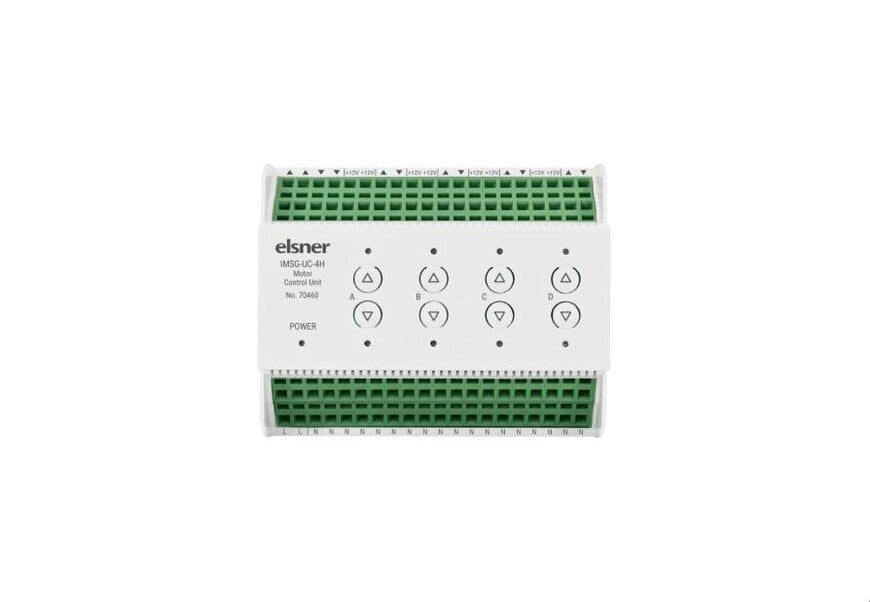
Expanding automated shading systems across multi-story buildings often requires electrical engineers to balance centralized weather-based control with localized manual operation. To address these scalability constraints in both new installations and retrofits, Elsner Elektronik offers the IMSG-UC series of intelligent motor control units to extend its WS1 and WS1000 building control systems.
In modern building automation, automated blinds, roller shutters, and awnings play a central role in regulating indoor climate and protecting facades from weather damage. Central building controllers such as the WS1 and WS1000 from Elsner Elektronik automate these shading elements based on sun position, brightness, and weather conditions. However, when a facility requires more shading drives than a central controller can directly manage—or when an existing installation must be expanded—engineers need a reliable method to group additional 230 V drives without losing individual room-level control.
Modular Architecture Of The IMSG-UC Series
The intelligent motor control units of the IMSG-UC series expand WS1 and WS1000 shading control systems by integrating additional 230 V drives into the overarching control concept. The devices allow multiple drives to be combined into logical groups while preserving individual on-site operation via dedicated pushbuttons.
In a typical multi-story shading application, a central WS1 or WS1000 unit manages automatic shading according to sun position and ambient weather conditions. Decentralized IMSG-UC devices actuate the individual shading drives on each floor. Through additional pushbuttons connected to the units, building occupants retain full local control over individual blinds or shutters whenever manual adjustments are needed.
Technical Specifications And Control Flexibility
The series is available in two hardware configurations tailored to different group sizes. The IMSG-UC-4H motor control unit controls four 230 V drives and provides one dedicated manual pushbutton connection per drive. For smaller shading groups, the IMSG-UC-2H variant manages two 230 V drives alongside two manual pushbutton inputs.
To accommodate diverse electrical infrastructures, both the central and pushbutton inputs support variable control voltages ranging from 12 to 80 V DC and 12 to 240 V AC. Central actuation can be configured for either latching or dead-man operation, depending on system safety and automation requirements. For local manual operation, installers can select between standard mode and comfort mode. Furthermore, the units allow a specific travel position to be stored individually for each connected drive.
To support system integrators and electrical planners during commissioning, Frederik Riedel and Fabian Gehring demonstrate practical application and wiring examples in a recorded webinar. The technical presentation details how motor control units can be cascaded, how varying control voltages are utilized, and how existing shading control systems are expanded using the IMSG-UC series.
Additional Context
This section details technical specifications and competitive benchmarking not included in the original product announcement.
In electrical building installation, standard 230 V AC tubular motors used for blinds, awnings, and roller shutters cannot be wired directly in parallel without electrical isolation. Connecting multiple single-phase AC motors directly to a single switch causes reverse currents to flow through the motor capacitors, which can lead to erratic movement, premature wear, or permanent motor damage. Dedicated motor control units resolve this engineering constraint by electrically isolating each drive output while coordinating centralized group commands.
Supporting wide-range universal control inputs—spanning 12 to 80 V DC and 12 to 240 V AC—provides significant flexibility in retrofit and mixed-infrastructure projects, allowing decentralized 230 V actuators to interface with legacy low-voltage building management systems or standard mains-voltage wall switches without external voltage converters. Additionally, the ability to cascade motor control units enables hierarchical control topologies, such as floor-by-floor grouping beneath a central weather station, offering a straightforward alternative to full fieldbus systems like KNX in smaller or mid-sized commercial buildings.
Edited by Maria Brueva, Induportals editor – adapted by AI.
