
Hybrid Intrusion Alarm Panel for Multi-Site Security
Hikvision introduces the MX Hybrid control panel to combine wired, BUS, and wireless sensors across residential retrofits and large industrial complexes.
www.hikvision.com
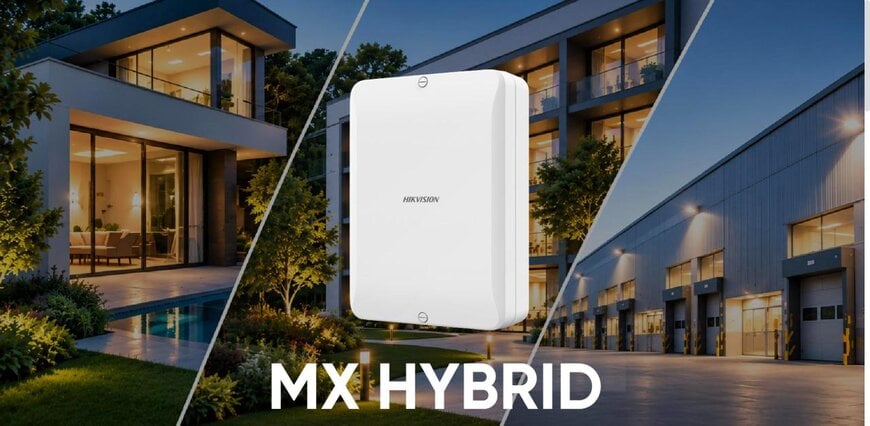
Securing properties that range from private residences to expansive manufacturing complexes requires balancing legacy wired infrastructure with scalable long-distance detection and differentiated access schedules. To address these diverse deployment requirements, Hikvision presented the MX Hybrid alarm control panel from its ProExpert selection on November 17, 2026, combining conventional wired sensors, BUS devices, and wireless peripherals within a single architecture.
In residential security upgrades and villa installations, electrical installers frequently encounter existing hardwired detectors alongside detached structures such as garages and outbuildings. Replacing an entire wired infrastructure increases civil works and installation costs, whereas relying exclusively on a single transmission medium limits placement flexibility across thick walls or outbuildings.
The MX Hybrid control panel addresses these retrofit constraints by allowing installers to select the most suitable connection method for each section of a property. Because the panel supports conventional wired sensors, including third-party devices, installers can retain existing compatible hardware while expanding protection into new areas via BUS or wireless peripherals. This mixed-topology approach upgrades overall intrusion protection while minimizing cabling interventions.
Long-Range BUS Architecture And Loop Redundancy For Large Facilities
Protecting industrial manufacturing sites, corporate office complexes, and hospitality venues introduces greater spatial and operational complexity, requiring coordinated monitoring across offices, warehouses, technical rooms, and detached buildings with independent operating schedules. Standard single-run alarm wiring often faces distance limits across wide perimeters.
To cover distributed sites, the MX Hybrid panel incorporates two independent BUS lines capable of spanning up to 7.5 kilometers when paired with dedicated extenders, a range comparable to the perimeter of Milan Malpensa Airport. The system scales up to 128 zones with area-based management, allowing security engineers to partition protection across distinct operational environments. Installers can deploy the BUS architecture in three configuration modes, namely Fast, Compatible, and Loop, to match specific site topologies. Utilizing the Loop configuration introduces physical communication redundancy, maintaining signal continuity across distributed field devices.
Video Surveillance Convergence And Multi-Path Connectivity
Across both residential gardens and industrial warehouse access points, relying solely on conventional alarm triggers often leaves operators without visual context during an event. Through native convergence with Hikvision video surveillance, compatible cameras operate as active detection components, transmitting video analytics events directly to the alarm control panel. When an intrusion alert occurs, integrated video verification clips help operators assess the trigger cause rapidly.
To maintain reliable alarm transmission and remote system administration, the control panel integrates LAN and Wi-Fi networking alongside a dual-SIM 4G communicator. For security installers, the Hik-Partner Pro platform centralizes remote configuration, system diagnostics, and ongoing maintenance. End users manage daily control and event monitoring through the Hik-Connect application and a dedicated 7-inch touch keypad, establishing a unified management workflow that scales alongside subsequent site extensions.
Additional Context
This section details technical specifications and competitive benchmarking not included in the original product announcement.
In commercial and industrial intrusion engineering, hybrid control panels have become a standard architectural solution for bridging brownfield hardwired installations with modern addressable BUS and encrypted radio-frequency sensors. Unlike basic daisy-chain wiring, where a single severed cable disconnects all downstream detectors, closed-loop RS-485 BUS topologies allow the control panel to poll devices from both directions in the event of a line break, preserving zone supervision across large campuses.
From a regulatory standpoint, European intrusion systems are classified under the EN 50131 standard across Grades 1 through 4, which define requirements for circuit supervision, tamper resistance, and alarm transmission redundancy based on site risk profiles. Combining IP connectivity with dual-SIM cellular communicators supports dual-path signaling to alarm receiving centers, mitigating single-point network outages. Furthermore, integrating edge video analytics and short video verification clips directly into intrusion workflows addresses one of the primary operational costs in commercial security by reducing false alarm dispatches.
Edited by Maria Brueva, Induportals editor – adapted by AI.
