
smartbuildingmag.com
27
'26
Written on Modified on
Wi-Fi 6 Access Points for High-Density Enterprise Networks
Hikvision introduces the EI Access Point series featuring Wi-Fi 6 technology, fiber connectivity, and IP68 protection to simplify wireless coverage across commercial, hospitality, and industrial environments.
www.hikvision.com
Ensuring reliable wireless coverage inside complex buildings and expansive outdoor zones remains a persistent technical challenge for network architects and system installers. Structural obstacles such as thick load-bearing walls, high densities of simultaneously connected client devices, and harsh outdoor weather conditions degrade signal integrity and introduce latency into enterprise communications. Overcoming these operational constraints requires radio architectures engineered for high spectral efficiency, diverse mounting form factors for targeted signal distribution, and centralized management platforms capable of optimizing radio frequency resources across multi-device deployments.
Wi-Fi 6 Radio Architecture and High-Density Optimization
To address connectivity demands in high-density environments, Hikvision launched the EI Access Point series, a nine-model wireless portfolio engineered to simplify installation workflows while integrating into the company's broader networking ecosystem. The lineup adopts the Wi-Fi 6 standard in AX1800 and AX3000 configurations, delivering aggregate wireless throughput up to 2976 Mbps and supporting up to 256 concurrent associated client devices per access point.
To maintain connection stability as users move across distinct coverage zones, the devices incorporate Auto RF Airtime Scheduling Optimization to allocate transmission time equitably, beamforming techniques to focus radio energy toward active receivers, and fast roaming protocols compliant with IEEE 802.11k, 802.11v, and 802.11r. Together, these mechanisms minimize handoff delays between adjacent access points, preventing packet loss and session drops during voice communications or mobile data transfers.
Diverse Form Factors and PoE+ Infrastructure Integration
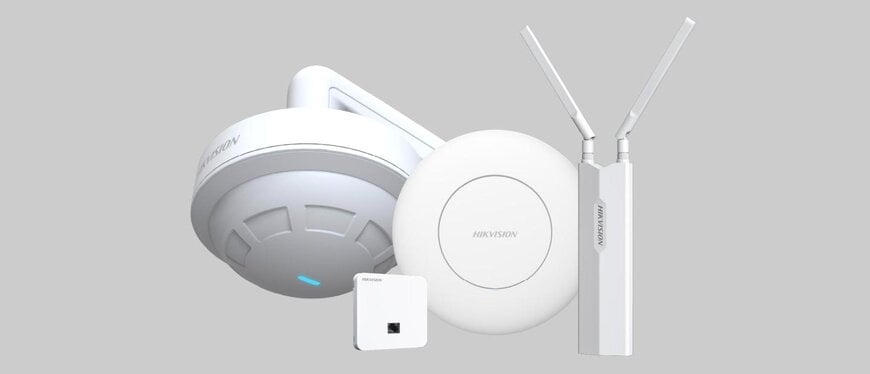
The EI series addresses varied architectural environments through three primary hardware form factors:
- Ceiling-mount models distribute omnidirectional wireless coverage uniformly across open indoor spaces such as corporate offices, retail stores, and educational classrooms.
- In-wall models are designed for flush mounting inside standard 86 mm electrical wall boxes, delivering dedicated Wi-Fi signals directly inside individual hotel and bed-and-breakfast guest rooms to bypass signal attenuation caused by interior walls and doors without disrupting room aesthetics.
- Outdoor models feature IP68 ingress protection against dust and continuous water immersion alongside Gigabit fiber optic interfaces, targeting parking facilities, logistics yards, and industrial complexes. A Wi-Fi 5 AC1200 outdoor variant completes the lineup for budget-constrained deployments.
From a cabling and power perspective, support for Power over Ethernet Plus (PoE+ IEEE 802.3at) enables data and electrical power transmission over a single Ethernet cable, reducing structural wiring complexity. Multi-device configuration, firmware deployment, and ongoing network monitoring are handled centrally either via smart routers equipped with integrated controllers or through the Hik-Partner Pro cloud platform. This unified management allows electrical installers and security integrators to deploy and maintain wireless networking infrastructure alongside physical security and video surveillance systems within a single ecosystem.
Additional Context
This section details technical specifications and competitive benchmarking not included in the original product announcement.
In enterprise wireless networks governed by the IEEE 802.11ax (Wi-Fi 6) standard, increasing capacity in congested environments relies on Orthogonal Frequency-Division Multiple Access (OFDMA) and Basic Service Set (BSS) Coloring. Unlike legacy Wi-Fi 5 (IEEE 802.11ac) architectures that dedicate an entire radio channel to a single client per transmission slot, OFDMA partitions channel bandwidth into smaller Resource Units, allowing an access point to serve multiple low-bandwidth terminals simultaneously while reducing medium contention. Concurrently, assisted roaming standards IEEE 802.11k, 802.11v, and 802.11r streamline neighbor radio reporting and pre-authenticate security keys, reducing transition latencies between access points to prevent interruptions in real-time voice and video traffic. For outdoor installations, IP68 certification under IEC 60529 provides complete protection against dust ingress and continuous immersion, exceeding the IP65 or IP67 ratings typical of standard commercial outdoor units, while Gigabit SFP fiber uplinks provide galvanic isolation against lightning-induced surges over runs exceeding the 100-meter limit of copper Ethernet.
Within the small-to-medium enterprise, hospitality, and commercial wireless networking market, the Hikvision EI series benchmarks directly against platforms from Ubiquiti UniFi (U6 Pro, U6 In-Wall, and U6 Mesh), TP-Link Omada (EAP610/EAP650 ceiling models, EAP615-Wall in-wall units, and EAP625-Outdoor HD), HPE Networking Instant On (AP22 and AP27), and Grandstream (GWN7660 and GWN7664LR).
Edited by Romila DSilva, Induportals Editor, with AI assistance.
